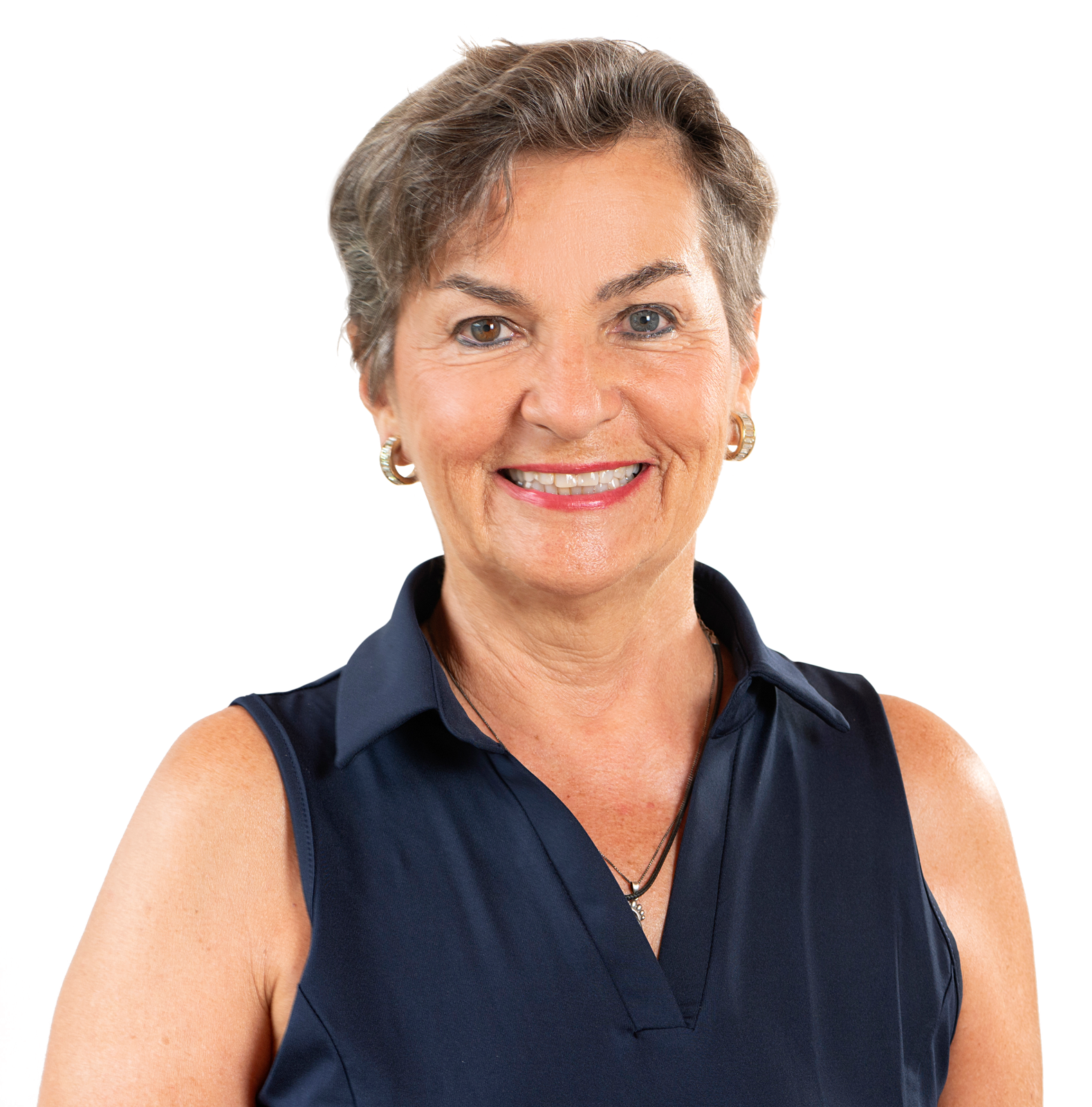
Christiana Figueres has spent three decades at the intersection of two questions that most people treat as separate: how do we change the world, and how do we change ourselves? Her answer — earned through both the highest rooms of multilateral diplomacy and the quietest seasons of personal reckoning — is that these are not separate questions at all.
Origins
She was born in 1956 in San José, Costa Rica, into a family at the center of the country’s political and environmental life. Her father, José Figueres Ferrer, was a three-time president who, in 1948, abolished the national army — an act that redirected a country’s resources from soldiers to teachers and biodiversity, and that turned Costa Rica into one of the world’s quiet experiments in what a society can choose to become. To grow up inside that household was to absorb, early and without sentimentality, the idea that the architecture of a nation is not fixed but made, and that the people who make it are ordinary people who decide to act with courage and conviction. It is a lesson she would carry into rooms where 195 governments could not, at first, agree on anything at all.
But the household that shaped her convictions about nations did not offer her the same steadiness about herself. Her parents’ marriage ended in a bitter divorce worn down by her father’s infidelities. The pain of it made her mother incapable of loving her children. She does not tell this story for sympathy but for honesty about where her convictions come from: when she later built a family of her own, she did so with profound deliberateness, determined to give her daughters, Naima and Yihana, the supportive environment and unconditional love she had not had herself.
Education
Figueres studied at Swarthmore College, graduating in 1979 with a degree in Sociology and Anthropology, and after a year of field work in Florida and Samoa, went on to earn a Master of Science in Social Anthropology from the London School of Economics in 1981. Anthropology would prove an unlikely but durable foundation for a career spent reconciling the irreconcilable: it trained her to read the unspoken but powerful logic of different cultures, to understand that every party at a negotiating table carries a worldview as much as an interest, and to build agreement not by overriding difference but by understanding it. She later complemented that training with professional study in organizational development, earning a certification from Georgetown University in 1991 and a certificate in organization and systems design from the Gestalt Institute of Cleveland in 1993 — disciplines concerned, in the end, with how groups of people change.
Building the Field
Figueres entered public life as a young diplomat. From 1982 to 1985 she served as Minister Counselor at the Embassy of Costa Rica in Bonn, Germany, directing the work of the embassy’s departments and renegotiating the terms of technical assistance and development finance between the two countries — work for which the German government awarded her the Great Cross of the Order of Merit. Returning home, she served in various public roles: as Director of International Cooperation at the Ministry of Planning from 1987 to 1988, where she designed and led the negotiation of dozens of projects with European partners; and as Chief of Staff at the Ministry of Agriculture from 1988 to 1990, where she oversaw the execution of a sweeping portfolio of national programs in training, credit, and marketing.
In the mid-1990s, having painfully witnessed the extinction of the golden toad species due to temperature changes on the forest floor, she decided to devote the rest of her life to addressing climate change. At the time, climate change was still a marginal concern to most, treated by governments around the world as a distant abstraction. Figueres saw it differently. From 1994 she directed the technical secretariat of Renewable Energy in the Americas, promoting policies to advance clean energy across Latin America. Then, in 1995, she founded the Center for Sustainable Development in the Americas, which she led for eight years and which became a Latin American laboratory for ideas that would later go global.
It was there that she helped conceive and establish the first carbon-finance program in the developing world, the Latin American Carbon Program, housed within the Andean Development Corporation. Under her direction it negotiated the first emission-reduction purchase agreement between an industrialized country and a regional development bank — an arrangement that committed 45 million euros from the Government of the Netherlands to purchase emission reductions across Latin America. She helped conceive and establish national climate-change programs in Guatemala, Panama, Colombia, Argentina, Ecuador, Honduras, and El Salvador; trained more than five hundred professionals across the public sector, the private sector, and civil society; and negotiated the first bilateral agreement on joint implementation between the United States and Costa Rica.
Negotiating for Costa Rica
For fifteen years, from 1995 to 2010, Figueres served as Costa Rica’s negotiator to the United Nations climate convention — a role that placed her inside the slow, granular, often thankless work of building international rules line by line. She specialized in the Clean Development Mechanism, the global market instrument designed to channel investment from rich countries toward emission reductions in poorer ones.
At the first Meeting of the Parties to the Kyoto Protocol in Montreal in 2005, she successfully negotiated the regulatory opening of that mechanism to “programs of activities,” a technical change with an outsized human consequence: it allowed the benefits of carbon finance to reach households and small enterprises rather than only large industrial projects. She co-chaired contact groups across the negotiations of the late 2000s in Nairobi, Poznań, Bonn, Accra, and Copenhagen; sat among the “Friends of the Chair” who negotiated the Bali Action Plan in 2007; and served as Vice President of the Bureau of the Convention from 2008 to 2009.
The United Nations and the Paris Agreement
In 2010, in the immediate aftermath of the political collapse of the Copenhagen summit — a failure so complete that it had cast doubt on whether multilateral climate diplomacy could work at all — Figueres was appointed Executive Secretary of the United Nations Framework Convention on Climate Change, with the rank of Assistant Secretary-General of the United Nations. She inherited a process in ruins and a near-universal assumption that a global agreement was impossible.
Over the next five years she set about, methodically and stubbornly, proving that assumption wrong. She recognized that the missing ingredient was not a better text but a different atmosphere, and she rebuilt the negotiation from its foundations: restoring trust among governments that had stopped believing in one another, and widening the circle of participants far beyond the diplomats. She brought together national and sub-national governments, corporations and activists, financial institutions and communities of faith, scientists and women’s groups, think tanks and technology providers, NGOs and parliamentarians — convening them not as adversaries to be managed but as co-participants of a shared outcome. In doing so she pioneered what came to be called a new brand of ‘collaborative diplomacy’, grounded in deep listening and in a relentless, almost obstinate optimism.
What she brought to that work was a reframing of the problem itself. The world had treated climate negotiation as a zero-sum contest in which any nation’s gain was another’s loss. Figueres insisted instead that a stable climate was a shared interest so fundamental that it dissolved the usual logic of winners and losers, and she set out to make every party in the room feel that the agreement was theirs to build rather than theirs to resist. She spoke, often, of “stubborn optimism” — not the naïve belief that things will turn out well, but the deliberate decision to treat a good outcome as achievable and then to work, collectively and relentlessly, until it was achieved.
That work culminated on December 12, 2015, in the adoption of the Paris Agreement by 195 sovereign nations — a collaborative path to hold the rise in global temperature well below 2°C, and to strive to limit it to 1.5°C, in order to protect the most vulnerable people in every country and to lay the foundation for shared prosperity. The agreement entered into force in under a year, faster than virtually any comparable instrument in the history of the United Nations. For an achievement that two decades of effort had failed to produce, Figueres has been credited the world over with making the impossible inevitable.
What none of the headlines captured was what the work had cost — and what it would take to continue.
A Contemplative Path
The work that produced the Paris Agreement had an interior dimension that Figueres kept private for most of her career. She speaks of it now because she believes it is inseparable from the work itself. Its roots lie in a season of personal rupture: in 2013, in the middle of her tenure at the United Nations and the most demanding stretch of the climate negotiations, a marriage undone by repeated betrayal dropped her into the deepest suffering she had ever known — a darkness in which, for a time, she lost her will to continue living — and she had to search for an inner ground on which to stand. It was then that she encountered the teachings of the Vietnamese Zen master Thich Nhat Hanh — on interbeing, impermanence, and on the dissolution of the boundary between self and world — which have nourished her ever since. Today she has come to realize that many climate and nature protection leaders and activists carry their own version of that pain — grief for the world often amplifying deep personal suffering — and she therefore offers worldwide retreats at the intersection of mindfulness and planetary care in consonance with the monastics of Plum Village. The retreats are loving invitations to face the pain, in order to find not only inner peace but a steadier ground from which to keep acting in the world. She also shares Dharma talks at Blue Spirit, Spirit Rock, and the Upaya Center.
Her spiritual practice is not a coda to her climate work but the source of its strength. The loving patience to sit in a fractured negotiation for five years; the capacity to meet hostility without absorbing it; the stubborn refusal to let despair, however understandable, have the final word — these were not strategies she adopted but disciplines she practiced and continues to apply to her life. The teaching of interbeing, that nothing exists in isolation and that the fate of any one being is bound to the fate of all, is, when you strip away the language, the same truth that the climate crisis forces upon a divided world.
She has come to speak openly about her dark days and the discovery of her own inner dimension because she believes it reflects the reality of the world we are living in. She also believes that a civilization will not protect what it does not feel itself to be part of, and that the work of repairing our relationship with the living world begins with remembering that we are an integral part of the natural world. The contemplative tradition she draws on offers no escape from the urgency of the moment; it offers, instead, a way of staying present to that urgency without being consumed by it, of holding both the gravity of the science and the genuine possibility of a different future in the same steady gaze. Paris was possible, she says, not despite this inner work, but because of it.
Global Optimism
Since leaving the United Nations in 2016, Figueres has continued to expand the boundaries of climate leadership. She is the co-founder, with Tom Rivett-Carnac, of Global Optimism, a purpose-driven enterprise dedicated to precipitating the shift from pessimism to optimism as a method of creating social and environmental change. Through it she convened Mission 2020, the global initiative to bend the curve of greenhouse-gas emissions, working to move the public conversation about climate change away from paralysis and toward possibility.
Global Optimism is also the home of Outrage + Optimism, the podcast Figueres co-hosts with Tom Rivett-Carnac and Paul Dickinson, which has become one of the most widely heard conversations on climate in the world — a space that holds both halves of its title at once, refusing to choose between clear-eyed anger at the scale of the crisis and grounded confidence about the human capacity to meet it. In 2020 she published, with her co-author Tom Rivett-Carnac, The Future We Choose: Surviving the Climate Crisis, a book that lays out two divergent futures and argues that the choice between them is still, narrowly, ours to make. It has been translated into 16 languages.
Boards and Public Service
The breadth of Figueres’s influence is reflected in the institutions that have sought her counsel. She served as the inaugural Chair of the Board of The Earthshot Prize, founded by Prince William in 2020, guiding the world’s most ambitious environmental prize through the first half of its ten-year mission to discover and scale solutions to repair the planet — until handing the chairmanship to Jesper Brodin in March 2026 and joining the Prize Council that selects its annual winners. She served from 2017 to 2024 as a non-executive director of the boards of Acciona and Acciona Energía, and has sat on the advisory bodies of major energy companies, including ENI.
She has held leadership roles across the architecture of global climate action: as a leader of the B Team, as Vice-Chair of the Global Covenant of Mayors for Climate and Energy, as an Ambassador of the Under2 Coalition, as a Commissioner of the Global Commission on Adaptation, and as a member of the Global Commission on the Geopolitics of Energy Transformation. She served as an advisor to the President of COP26, and on the steering committees of the United Nations Secretary-General’s Climate Summit and the Global Climate Action Summit.
Her board and advisory service spans the leading institutions of environmental research and philanthropy — among them the World Resources Institute, ClimateWorks, Conservation International, where she was named a Distinguished Fellow, and Winrock International. She chaired the High-Level Advisory Board of the Lancet Countdown on Health and Climate Change, was named a Climate Leader by the World Bank, and was a Fellow of DeepMind’s Ethics and Society initiative.
Awards and Recognitions
Governments around the world have conferred their highest civic honors on Figueres. She holds the Great Cross of the Order of Merit of Germany, the Légion d’Honneur of France, and the Grand Medal of the City of Paris; in her native Costa Rica, the National Guayacán Medal and the Decoration of Merit for Peace and Democracy; and from the Netherlands, appointment as an Officer of the Order of Orange-Nassau. In 2022 she was named an honorary Dame Commander of the Order of the British Empire.
Civil society honors include the Ewald von Kleist Award of the Munich Security Conference, the International Four Freedoms Award, the Edinburgh Medal, the Dan David Prize, the Sydney Peace Foundation’s Gold Medal for Human Rights, the Hillary Laureate, and the Great Negotiator Award of the Program on Negotiation at Harvard Law School. The Parliament of the World’s Religions awarded her its Ecological Flourishing Award. In the years surrounding Paris she was ranked first among Nature’s ten people who mattered in science, named a Global Thinker by Foreign Policy, placed seventh on Fortune’s list of the World’s Greatest Leaders, and included on the Time 100.
Perhaps the most fitting tributes have come from the living world she has spent her life defending. A newly discovered tropical moth (Struthoscelis christianafigueresae), a parasitic wasp (Pseudapanteles christianafigueresae), and an orchid (Vanilla karen-christianae) all now carry her name, and in 2017 Costa Rica issued a commemorative postage stamp in her honor.